No jokes - Cape Town’s dam levels drop to 47,8%
01 April 2026
While it may be April Fool’s Day today, the call for everyone living, working and visiting Cape Town to save water is no joke. The truth is that Team Cape Town’s collective water usage over the next two months - April and May- matters. This is because we all need to manage our current dam levels together so that it can last possibly until next year, without depending on unpredictable rainfall this year. Cape Town is not in a drought, and not heading to ‘Day Zero’. However, as we are in the early warning phase, the window to avoid water restrictions before November is narrowing as our collective usage remains high.
Current dam levels and how much water Cape Town has used
Over the past week, water usage has decreased to 1 014 million litres of water a day (MLD) from 1 022 MLD last week.
This is 39 MLD over the usage target.
Cape Town’s dam storage levels currently stand at 47,8%.
We need to save as much water as possible by the last day of May so that we have more water stored ahead of the winter rains, which is predicted to be less than average.
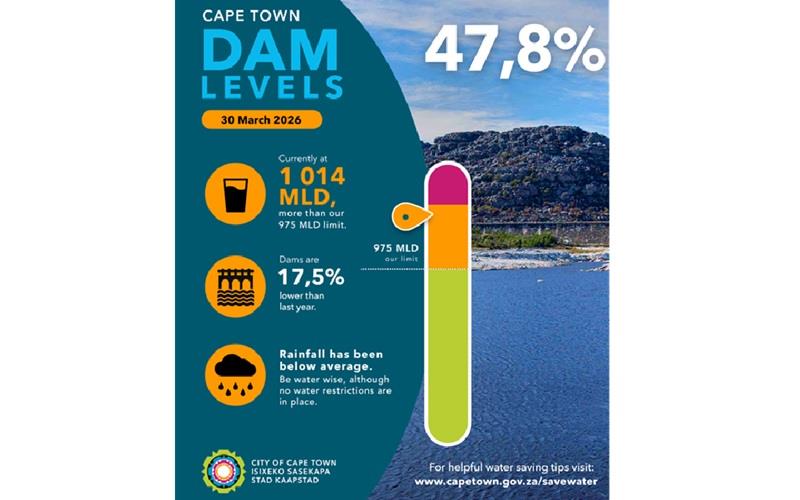 Facts about Cape Town’s water status
- Our collective water usage between now and the end of May (when we expect the start of winter rainfall) matters. We need to make changes now so we can keep our dams fuller. We will be in a better position if we use less water now and are able to delay possible restrictions, which no one wants. If demand remains high, the City’s options narrow and the likelihood of restrictions being introduced earlier than November, increases.
- The City may, based on its own assessments of water usage, dam levels and long-term weather forecasts, propose water restrictions before the next Annual Operating Analysis done by the National Department of Water and Sanitation (DWS). The City is and will continue to closely monitor dam levels and water use closely, especially between now and May. November is when DWS decides on whether a municipality needs to implement water restrictions for the upcoming hydrological year.
- Cape Town is not in a drought, however, the window to avoid water restrictions later this year is narrowing. Based on the current water usage trend, dam storage could drop as low as 40% by May if this year’s rainfall is average.
- Cape Town is in an early warning phase that reflects lower-than-expected dam levels and signals the need for continued careful use of water.
- The water system is entering a more sensitive period as every drop counts ahead of unpredictable winter rainfall.
Team Cape Town, let’s continue to save water together
‘Team Cape Town, Cape Town’s dam levels are 47,8% - no jokes. Let’s work together to save water because this 47,8% water that we have in our dams will need to last Cape Town with supply through both this winter and possibly into next year, depending on how much rainfall we get this year. In the face of unpredictable rainfall, we cannot depend on what winter will bring. We can only be certain of what we currently have now.
‘Thank you to our residents who have been using less water but we urge all of us to get on board as every drop counts and more needs to be saved.
‘Also, as we enjoy and relax this long weekend, and use water for different reasons, let us do so responsibly.
‘About 70% of all water used in the city is used in homes. This is why saving water at home is so important. Every water saving action matters, whether it’s closing the tap while you are brushing your teeth, fixing the nagging cistern of your toilet, taking short-stop showers, or watering your garden early in the morning or in the evening, even using less water to wash your cars at home.
‘Every daily water saving action adds up and can change the overall usage trend we are seeing. At this current trend, our dam levels will be 40% by May. We need to turn this trajectory around, Team Cape Town so that together we use less water to help manage our dam levels to avoid water restrictions being implemented earlier than November.
‘Our collective water use continues to be way over the target of 975 MLD that has been set to help us collectively manage our supply until winter.
‘Team Cape Town, please remember to use water wisely and responsibly in and around our homes, businesses and industries, and for essential purposes only,’ said Councillor Zahid Badroodien, Mayoral Committee Member for Water and Sanitation.
Tips to keep water usage down:
- Find and fix water leaks on your property.
If dripping taps, leaking toilets and faulty plumbing go undetected and ignored for a long time, a lot of water is wasted. - Monitor your own usage and make the effort to save water.
About 70% of all water used in the city is used in homes, which is why saving water at home is so critical. Only water the garden at night to prevent evaporation and avoid topping up swimming pools or pool inflatables unnecessarily. - Report burst municipal pipes immediately to the City through formal channels.
There are various ways to report a leak or a pipe burst:
- Switch to treated effluent re-use for industrial irrigation or construction purposes.
The City promotes and supplies treated effluent to large water users such as industry, sports clubs, golf clubs, large new developments and schools.
Information:
Published by:
City of Cape Town, Media Office